
A fall garden need not retreat into stillness. Instead, it can flourish through layered textures—dried seedheads, persistent foliage, and late-season blooms that transform light into new visual effects. The foundation lies in selecting perennials that maintain their structure long after summer’s peak, where foliage shifts from green to gold to deep pink, and where form carries as much weight as color.
One plant that consistently delivers this effect is tall sedum. Often overlooked as mere filler, it proves its worth when its thick, succulent leaves stand in stark contrast to wilting petals and browned stems. Its flat-topped clusters begin as muted green in summer before deepening into pink or mauve by autumn, introducing unexpected drama. Unlike annuals that wither after blooming, sedum retains its structure through winter, providing texture even as flowers fade.
When combined with dwarf blue spruce, the result is a year-round visual contrast. The conifer’s frosty blue needles anchor the design, while sedum varieties like ‘Autumn Joy’ or ‘Matrona’ rise vertically above. Adding mealycup sage (Salvia farinacea ‘Victoria Blue’) introduces another dimension: its slender spikes mirror the sedum’s form while contributing blue-purple blooms from spring through fall. Pruning the spruce in early spring keeps it contained, but leaving sedum’s dried flowers undisturbed ensures winter interest.
A single row of sedum ‘Autumn Joy’ serves as the anchor, its pink blooms intensifying as they age. Above it, sweet autumn clematis (Clematis terniflora) spills over a fence, its fragrant white star-shaped flowers appearing in late summer. While the vine spreads prolifically, requiring occasional thinning, its late-season display justifies the maintenance.
Read Also: Selecting Quality dining room furniture and living room furniture for Your Home
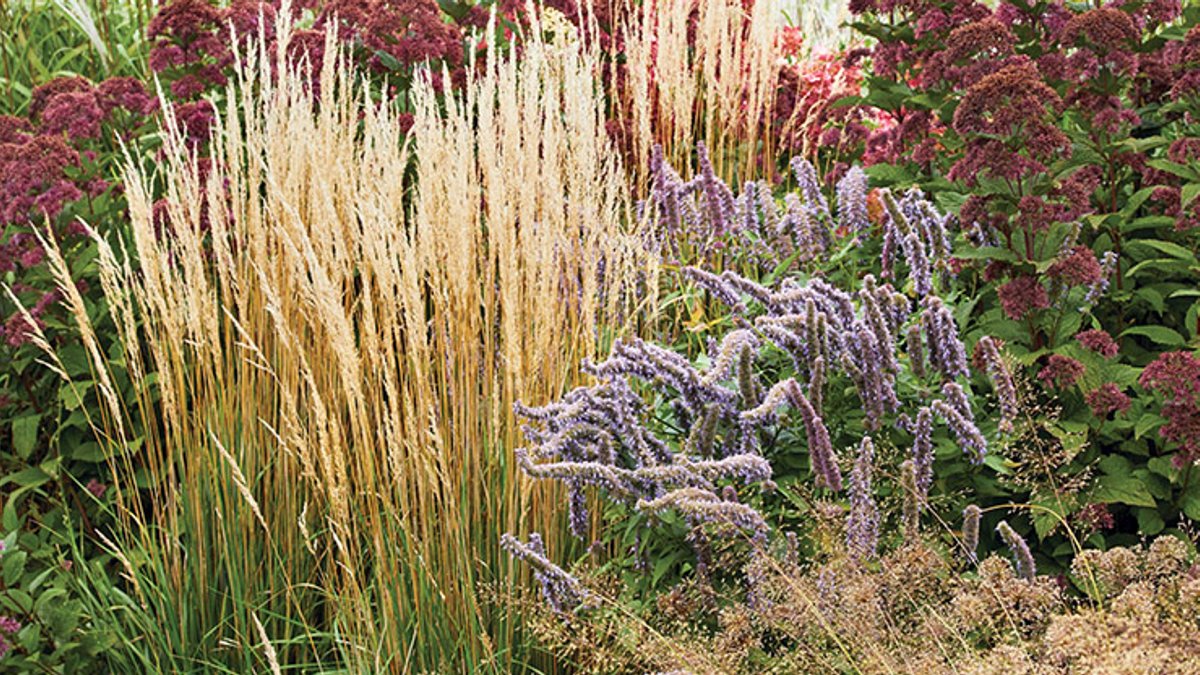
Beyond sedum, Joe-Pye weed and anise hyssop are late-blooming favorites for pollinators. Their purple and lavender spikes sustain migrating monarchs, while feather reed grass (Calamagrostis × acutiflora ‘Karl Foerster’) adds texture with its golden-beige flower heads. No deadheading is needed; spent flowers keep interesting texture deep into winter.
For high-impact borders, clustering fine-textured flowers, such as those of Joe-Pye weed, creates visual mass without overwhelming the scene. The key lies in density: grouping plants ensures their delicate shapes remain cohesive from a distance. Each selection should contribute a distinct trait, whether through color, height, or flower shape, to avoid repetition.
Effective fall combinations balance color and structure. A border dominated by firecracker plant, with its bright orange tubular blooms, can overpower a space unless softened by contrasting foliage. Pairing it with yellow buttons (fuzzy blue leaves) and golden bronze sedge tempers the intensity, while its appeal to hummingbirds adds ecological value. Containers work well for close viewing, allowing the plant’s vivid hues to stand out without dominating the garden.
Successful implementation depends on testing these pairings under varying light conditions. Shade-tolerant sedums perform best in partial sun, while Joe-Pye weed thrives in full light. Placing a plant in the wrong conditions can disrupt the intended balance, so site-specific considerations are as critical as the plant choices themselves.