
O’DonnellBrown, a Scottish architecture studio, focuses on adaptive reuse projects that give back to the community. The firm specializes in transforming often tricky vacant or historic buildings across the UK, imbuing them with fresh purpose and functionality. According to Jennifer O’Donnell, the goal is to provide a viable future for redundant public assets taken on by charitable organizations.
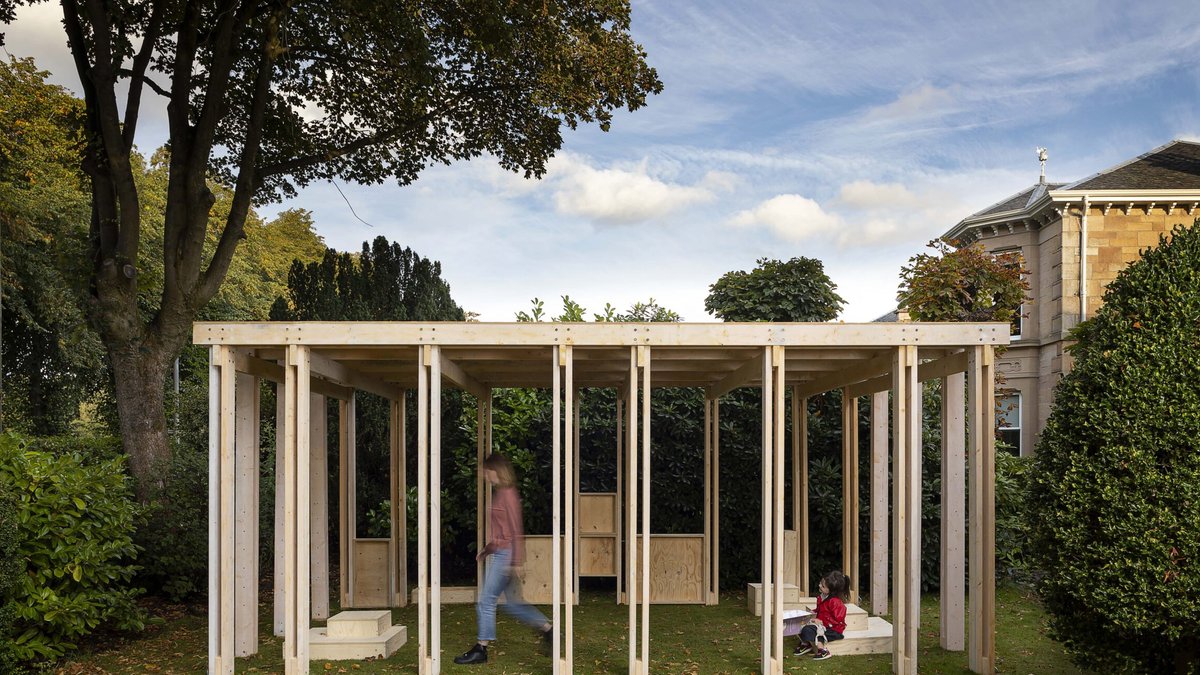
From outdoor classrooms to riverside parks, the studio’s 2019 Community Classroom stands as a self-initiated prototype built outside their Glasgow studio. Designed in collaboration with a UK charity that supports young people entering trades, the outdoor learning pavilion uses a demountable “kit of parts.” Sam Brown explained that the structure relies on simplicity.
Only three lengths of timber were used in the entire structure, a detail that drove the design. The pavilion was made of timber, plywood, and Monarflex, a waterproof fabric typically used on scaffolds that could be draped over the structure. Users could open and close each side as required.
Related: Culture Inspires These Eight Design Collections
This concept has evolved into more iterations, including an in-progress, off-grid learning facility for Edinburgh University in rural central Scotland. Another heir to the typology is the Take a Bow Opportunity Centre in Kilmarnock, Glasgow, completed in 2025. The firm led a renovation of a poorly insulated, damp, and asbestos-ridden 1970s-era community center into a space for a performing arts and youth development charity.
O’DonnellBrown’s retrofit proposal for Take a Bow involved serious insulation upgrades to the walls, roof, and floor. They opened up the front elevation with larger windows and moved the parking lot to the back to create new public space that melds into the adjoining park. The firm also added a modest extension on the facade to create a proper changing area near the stage.
The architects collaborated with energy consultant Carbon Futures to develop an energy strategy aligned with net-zero ambitions, reducing the building’s overall energy and carbon emissions by 70 percent. By adding a glulam colonnade across that elevation, they unified the new and existing parts of the building but also created an improved sense of arrival.
Related: Students Link Community Through Innovative Projects
Michael Dougall, a director at O’DonnellBrown since 2022, noted that the resulting timber canopy provides a covered space used by the adjoining cafe and for outdoor performances. This canopy represents a continuation and refinement of the detailing developed for the Community Classroom.
The firm also recently completed the Millport Town Hall on the Island of Cumbrae. The project began as a feasibility study back in 2018 and took six years to finish. A local group made over 140 funding applications and won 50 percent of them. The hall now houses a large space for ticketed performances, several smaller spaces.
O’DonnellBrown is also working on the conversion of the Pipe Factory in the city’s East End into office and educational spaces for a local arts organization.
Related: 2026 Planet Positive Awards Jurors Announced
There is often tension between balancing a conservation approach with much needed energy improvements. Jennifer O’Donnell believes conservation and retrofitting aren’t separate specialties because the same principles apply. These principles include understanding the significance of the site and structure, repairing before replacing, retaining embodied carbon, and designing for reversibility.
The firm is currently working on the Govan Graving Docks site on the south side of Glasgow. This historic shipbuilding site has been vacant since the late 80s. When the practice started working on the masterplan for Govan Graving Docks back in 2020, they spent almost three years having conversations and running workshops with over 20 local organizations and various government and city institutions. The process focused on understanding what the community really wanted.