
An undergraduate design student in Arkansas has drawn attention for two projects that rethink how buildings can serve communities—one for adolescent mental health, the other for climate-resilient housing in New Orleans.
Design as a language for everyday life
Dakota Kalkstein, a student at the University of Arkansas, approaches design as something that should be “recognizable and tangible to the people who build, use, and live within it.” His work focuses on bridging the gap between abstract concepts and practical, lived experience.
Kalkstein’s project Pathways of Connection proposes an adolescent mental wellness facility embedded in Fayetteville’s greenway system. The design repurposes a mass timber building to create a space that blends public amenities—a café and bike repair shop—with private patient areas. Exposed cross-laminated timber joints, large openings, and a central commons are meant to reduce stress and encourage interaction without forcing it.
Related: Barcelona Hosts UIA 2026 Amid Complex Debates
The facility sits within an existing network of trails and public spaces, making it feel less like an institution and more like a natural extension of the city. That choice reflects a broader shift in mental health design, where isolation is replaced with subtle connections to nature and community.
Not every design student can translate theory into buildable solutions. Kalkstein’s ability to balance concept and execution stands out, particularly in a field where ideas often remain on paper. His work suggests that good design doesn’t have to be expensive or exclusive—just intentional.
Climate adaptation meets cultural preservation
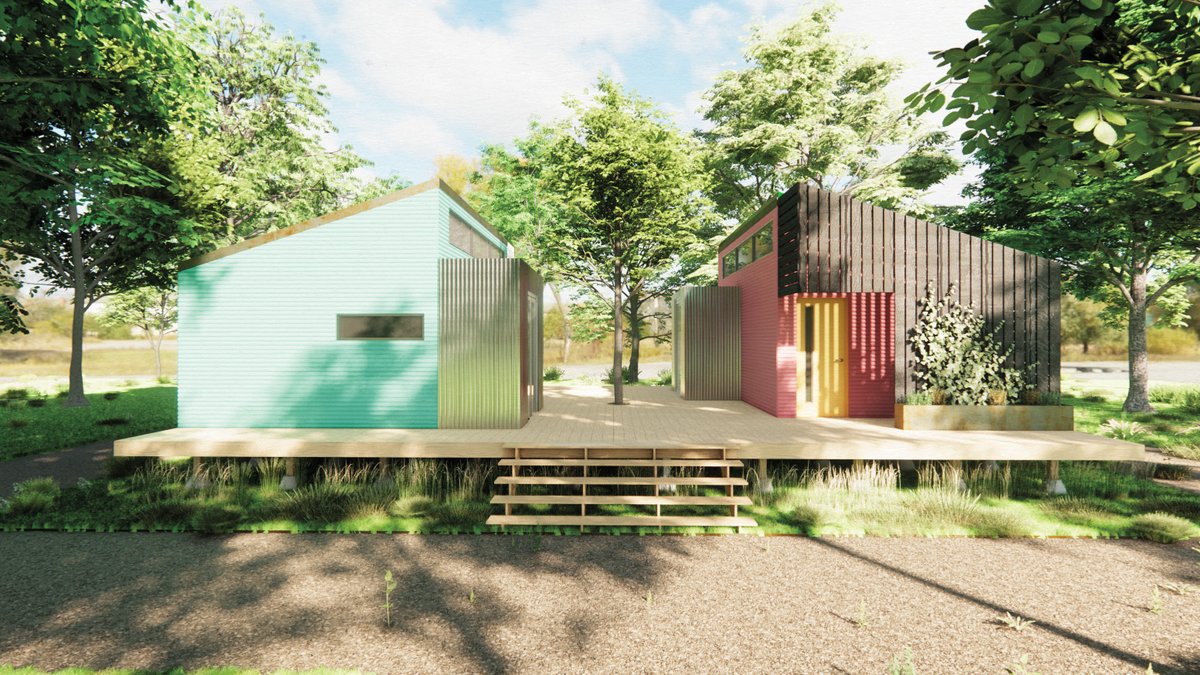
In Little Easy, a proposal for a New Orleans microhome competition, Kalkstein and collaborators Drew Schillings, Campbell Osier, and Turner Cane reimagined the city’s iconic shotgun houses for rising sea levels. The design raises the traditional layout into puzzle-like structures, with shared kitchens and social hubs to encourage neighborly interaction.
The project draws on the Haitian origins of the shotgun house, a style that has shaped New Orleans’ architectural identity. By adapting rather than abandoning that heritage, the proposal aims to support the city’s diverse communities while addressing environmental challenges.
Related: Craftsmanship Revived in Modern Architecture Designs
Jake Tucci, an assistant professor at the Fay Jones School of Architecture and Design, describes Kalkstein as someone who “learns quickly, approaches new challenges with calm dedication, and executes his ideas with thoughtfulness and exceptional craftsmanship.” That combination of curiosity and discipline is rare in student work, where ambition often outpaces follow-through.
The projects were recognized as part of the Future100 2026 program, which highlights emerging talent in architecture and design. While student work often prioritizes bold ideas over practical constraints, Kalkstein’s proposals feel grounded in real-world needs—whether it’s mental health care or climate resilience.
That balance might be the most promising part of his approach. Design, after all, isn’t just about aesthetics or innovation. It’s about making spaces that work for the people who use them every day.