
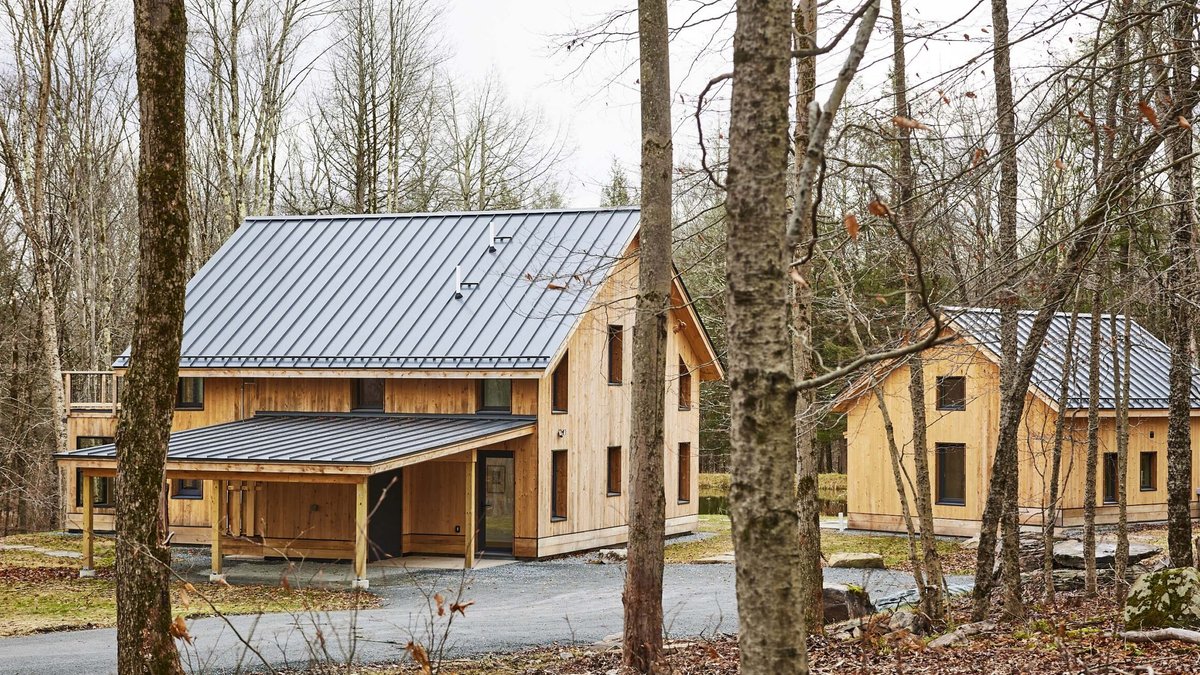
The Catskill Project is a 90-acre community of carbon neutral homes designed with residents’ health and wellbeing in mind. It’s a significant development, as it’s the first entirely passive house community in the Northeast.
The project is located in the western Catskills, in the hamlet of Livingston Manor. The 90-acre site features six finished homes, five of which have sold, and one remaining model.
Greg Hale, senior advisor to the New York State Energy Research and Development Authority, and Peter Malik, whose career has spanned conservation, real estate development, and law, met at the National Resource Defense Council some 15 years ago and hatched the plan to build a passive house community.
They required an architect and found an expert in Buck Moorhead, a pioneer in sustainable design since the 1980s and current Board Chair of New York Passive House. Malik explains that developers typically push the sustainability level of houses as far as they can without affecting profit margins, but they did it backwards.
Malik and Moorhead were both clear fans of the area, having houses in the vicinity already. They were also drawn by prices less eye-watering than more easterly portions of those mountains.
Passive house design is tricky, involving a repeat series of steps where the easiest means to accomplish one goal are generally things they’ve forbidden themselves from doing. Malik notes that the simplest and most energy-efficient way to build a passive house would be to build a bunker with tiny windows, but it wouldn’t be a desirable living space.
They hit upon the expedient of largely using off-site panelized construction, finding the right match in Bensonwood of Walpole, New Hampshire. The manufacturer employs a certified passive house designer and they found its systems a strong start.
Moorhead, who has designed numerous houses on his own, was making a leap into a new kit of parts. This was the first time he had done that before, and it turned out to be fascinating. To get the economy of working with them, they really needed to work within their system.
Related: Well Pump Suppliers and Expert Well Pump Repair: A Guide for Homeowners
They have built three of these Balsam models and three of a later smaller and lower-cost Red Hill models. Each model has 3 bedrooms and 2.5 bathrooms.
Sourcing was another central concern. Malik notes that if they don’t think about embodied carbon in their building materials, it could take them forty years to get back to zero. The project minimized the use of high-carbon steel and concrete.
Hale attests to countless tweaks in their quest to achieve a final product that fits together like a glove. He found himself won over and decided to move in.
Greg Hale, senior advisor to the New York State Energy Research and Development Authority, and Peter Malik, met at the National Resource Defense Council some 15 years ago and hatched the plan to build a passive house community.
The project is a demonstration of vital work for a more sustainable future.
Malik concludes that they will share their approach and lessons learned because the planet needs it. Once they succeed, they hope to replicate the project in other states. The project is going through the process of Passive House certification, which will further solidify its position as a leader in sustainable development.
The developers are committed to creating a more sustainable future.