
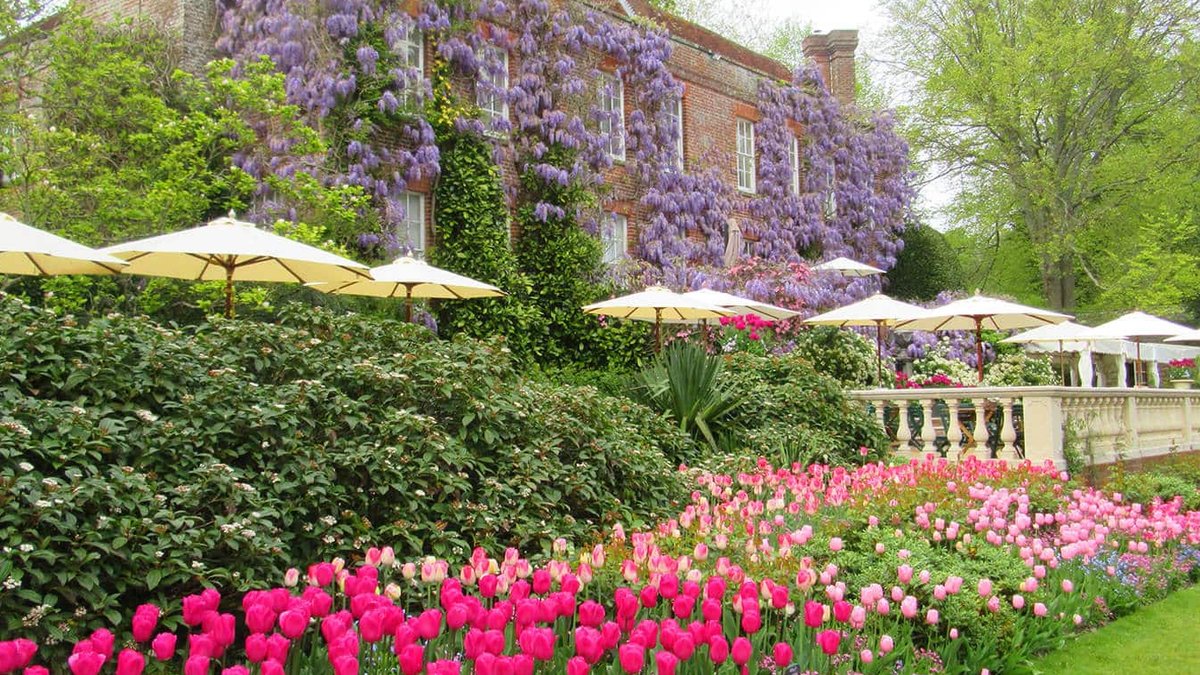
Bloms Bulbs has spent 160 years refining the art of tulip displays, and its two show gardens—Pashley Manor Gardens in East Sussex and Constable Burton Hall in North Yorkshire—offer a masterclass in how to turn spring borders into bold, intentional statements. The approach is deceptively simple: start with what you see most, then layer colour and repetition to create movement. The result is not just a garden, but a sequence of views that unfold as you walk through it.
At Pashley Manor, the tulips begin near the house, where 50,000 bulbs stretch in blocks of pink and magenta along the terrace. The effect is deliberate: from a café table, the colours feel effortless, but the planning behind them is precise. “My starting point is always the part of the garden I see most. At home it might be the patio, the path to the front door, or whatever you can see from the kitchen sink.
I tend to go over the top with pots on the patio for exactly this reason, because they give pleasure even on the days when I am less inclined to go out,” says the family behind the nursery. The key, they note, is scale, not spreading bulbs thinly across a wide area, but grouping them so they command attention.
Walking the long borders at Pashley, the pattern repeats: tulips are never scattered randomly. Instead, they appear in defined clusters, with the same colours reappearing further along the path. This creates a visual rhythm, guiding the eye down the border. The gaps between shrubs and perennials are filled with tulips, too, turning what might otherwise be bare patches into pockets of colour. In the formal garden, low box hedges frame each block, reinforcing the structure. The lesson is clear: tulips work best when they’re part of a larger design, not an afterthought.
Read Also: Garden experts offer heatwave recovery tips
Small-scale gardens make bold statements
Constable Burton Hall, by contrast, works on a smaller scale with 6,000 tulips spread across formal and woodland gardens. Each year, the borders get a fresh colour theme, proving that tulips don’t need to be planted in vast quantities to make an impact. The approach is the same: begin with the mood, whether bold reds or soft pinks, and then select varieties that complement it. A single pot of red tulips can stand alone, while mauves and near-black varieties add depth when paired with darker backgrounds like brick or hedges.
One detail often overlooked is the flowering month. April and May tulips can extend the season, but they won’t bloom simultaneously. Checking catalogues beforehand ensures colours align as intended. Another practical consideration is the pot. Tulips like Prince Collection varieties, Candy Prince, Purple Prince, and Sunny Prince, are early singles around 40cm tall and flower in April, making them ideal for terracotta pots. Their uniform height and timing keep them in proportion, whether planted alone or in groups.
Eight steps to design tulip moments
For those looking to replicate the effect, the nursery’s online guide breaks the process into eight steps: begin where you look most, group colours intentionally, repeat varieties for continuity, fill bare patches, choose bold or soft palettes based on the backdrop, match flowering times, select bulbs that fit the pot, and plant by late autumn or early winter. The result isn’t just a garden; it’s a series of moments, each designed to be noticed.