
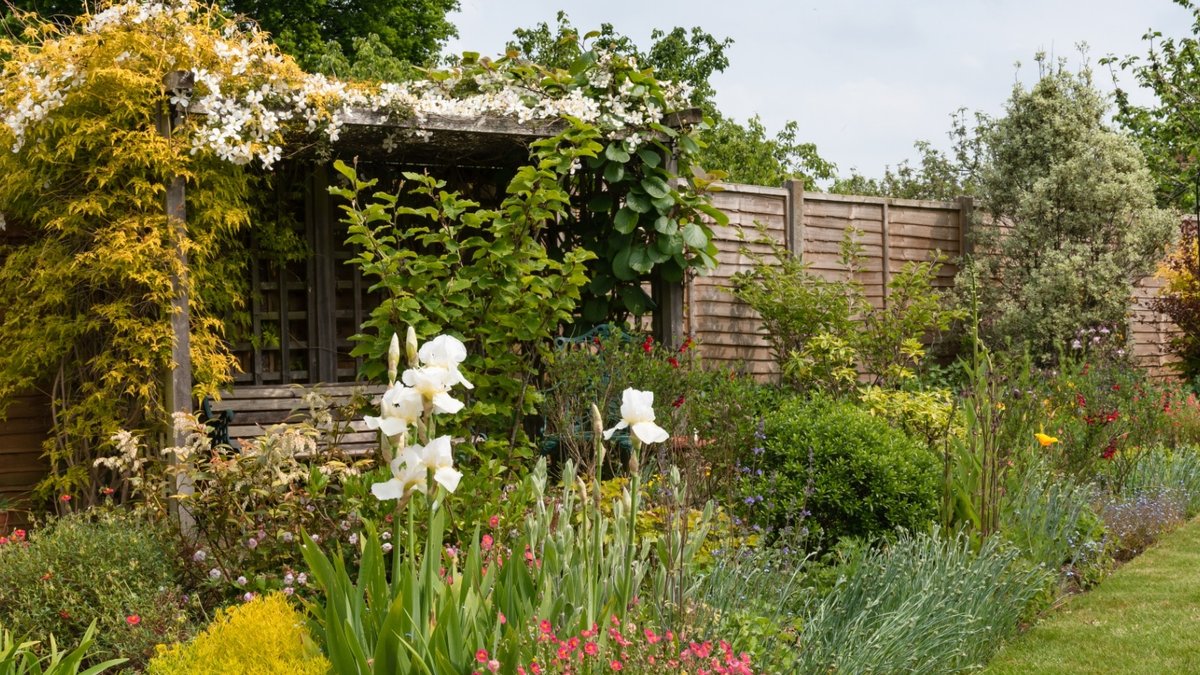
Small gardens demand precision. A misplaced shrub in a courtyard creates a glaring error that ruins the whole space. Most of these problems come down to a few habits that are easy to fix. Autumn is the ideal time to correct them because the soil is still warm and nurseries are full of stock. A few key adjustments can transform a cramped area into a layered, inviting environment before the first frost arrives.
Layering height creates depth
Many gardeners try to keep everything low to avoid an overwhelming feeling. This creates a flat, monotonous carpet of green that fails to draw the eye. Without height and layers, the space feels smaller, not larger. Designers recommend thinking in three tiers. Soft plants should spill out at the front, mid-height perennials form the body, and a few airy plants rise above the rest. Selecting see-through species for the top tier adds drama without blocking light or views.
Planting in rigid rows can make a scheme look stiff and unnatural. A looser, more random placement often retains more personality. One effective strategy is to use alliums for their tall, floating flower heads. An obelisk provides instant vertical structure, especially when a clematis climbs it. The goal is to create clusters of interest rather than a uniform spread.
One writer who maintains a small urban plot notes that trees often seem too risky because of their potential size and root systems. However, the right tree is the most transformative element available. It provides height, structure, and seasonal drama while offering privacy and shelter for birds. Autumn is the perfect planting season because roots establish during the winter months.
Choosing the right species matters more than avoiding trees altogether. Gardeners should look for trees with an open canopy and interest in multiple seasons. Amelanchier lamarckii offers spring blossom, summer berries, and autumn colour. The paperbark maple has distinctive peeling bark that glows in winter. Crab apples like Malus ‘Evereste’ keep fruit on the branches after the leaves fall. Multi-stem forms work well in tight spaces, and lifting the lower branches allows plants to be grown underneath.
Large containers improve small spaces
Scattered pots on a patio represent the most common mistake in small gardens. While charming individually, they create visual clutter and dry out quickly, requiring daily watering. A better approach is to use one or two large containers. They hold more compost, which retains moisture better and provides insulation for roots in winter. A single large pot can even house a small tree, such as a Japanese maple or a multi-stem Amelanchier, adding height to a terrace without any soil.
Design with restraint
Trying to include “one of everything” often results in a disjointed patchwork. A more sophisticated design relies on repetition to create rhythm. Selecting three to five key plants and repeating them in groups of three or five allows the eye to drift naturally across the space. This also helps with budgeting because dividing perennials can create several new plants for free.
Designers advise sticking to a restrained colour palette. Two or three colours mixed with plenty of green look far more professional. This focus simplifies the shopping process and ensures a cohesive look throughout the garden.
Design for interest all year round
Most people plan gardens for June, when local centres are packed with blooms and the evenings are long. However, this overlooks the other seven months of the year when the garden is viewed from indoors through rain-streaked glass. The most successful small gardens provide interest every month from January to December. This requires building in evergreen structure from the start.
A writer who planted a multi-stem Amelanchier lamarckii in autumn 2023 noted how its spring blossom drew bees within weeks of planting. The tree’s berries arrived in early summer, and by October, its leaves turned fiery orange, outlasting most perennials. Birds—including robins and blackbirds—frequented the branches, while the dappled shade it cast made the adjacent patio usable even on hot afternoons. The same approach worked with Cercis canadensis ‘Forest Pansy’ in a courtyard, where its burgundy foliage framed a sitting area without overshadowing it entirely.
For those without ground space, large containers became the solution. A photographer who received a unit of Japanese maple ‘Bloodgood’ in a 24-inch stone-glazed planter reported it thrived with minimal staking, its leaves deepening in colour each autumn. The pot’s weight also eliminated the need for anchoring, while the tree’s slow growth meant it never outgrew the container. Similarly, a haematologist who treats patients in the region grew a Prunus ‘Pandora’ in a matching pot on a balcony, its pink spring flowers visible from upstairs windows. Both cases proved that height could be achieved without soil—provided the container was at least twice as wide as the plant’s mature spread.
Year-round interest required deliberate choices. A environment designer who specialises in urban plots avoided collapsed perennials by leaving ornamental grasses, Stipa gigantea and Calamagrostis ‘Karl Foerster’, untrimmed until late winter. Their seedheads, dusted with frost, remained upright, while the dried stems of Echinacea purpurea and Phlomis purpurea held their shape through rain. These plants also attracted goldfinches and sparrows, which foraged among the stems. Meanwhile, Cornus sanguinea ‘Midwinter Fire’ provided the only red foliage in December, its stems glowing against bare branches.
Winter scent adds fragrance to garden
Winter scent was equally critical. Sarcococca confusa, planted beneath a window, emitted its vanilla fragrance during January thaw, strong enough to perfume the room when doors were open. A neighbour who grew it in a shaded corner reported the scent lingered for hours after pruning. Nearby, Hellebores, both Helleborus niger and Helleborus ‘Winter’s Song’, bloomed in late February, their nodding flowers catching light through rain-streaked glass. These choices ensured the garden remained engaging even during months when most plots appeared dormant.
Borders that encroached on lawns solved two problems at once. A writer who reshaped their plot eliminated mowing entirely by replacing the grass with Aquilegia vulgaris and Digitalis purpurea, which self-seeded annually. The deeper beds allowed for Berberis thunbergii ‘Atropurpurea’ at the back, its spiny stems deterring cats while its red foliage provided winter structure. The same technique worked in a narrow strip between fence and path, where Viburnum tinus and Ilex crenata formed a living screen without crowding the space.
The final adjustment came in materials. A family who renovated their patio used only two paving types, a mid-tone limestone for the main area and a complementary gravel for paths, echoing the house’s stonework. The larger slabs, laid in tight joints, made the space feel wider, while the gravel’s neutral tone prevented glare. When combined with a single type of edging (a smooth brick), the result was a cohesive look that required no seasonal adjustments. The same principle applied to fences: sticking to one style, whether close-boarded wood or metal lattice, prevented visual clutter before planting began.