
Marymount University interior design graduate Zhuyun (Joy) Xu was named a 2026 METROPOLIS Future100 honoree for work that puts emotional well‑being, interaction and accessibility at the forefront of public spaces.
Designing an outdoor music park for all ages
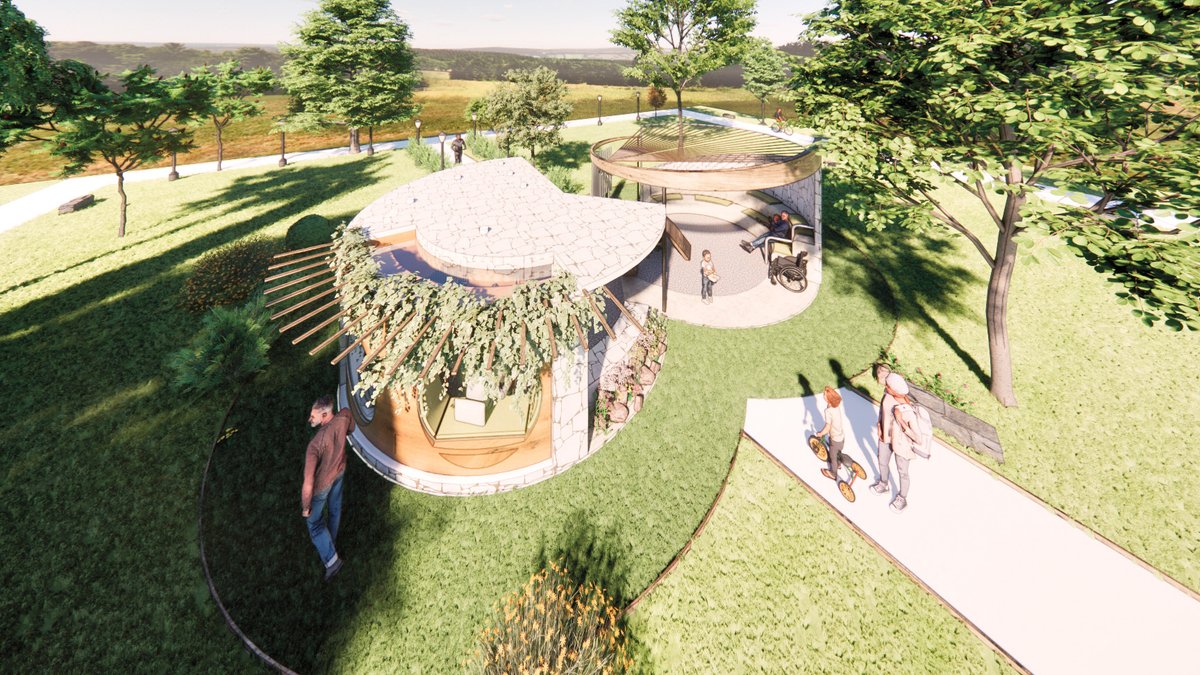
Xu’s primary project, the Symphony Grove Music Garden, is an infinity‑loop–shaped outdoor venue that aims to bring together youth and older adults. The layout includes a floor‑embedded piano and a music visualizer that converts sound into light, creating an experience that engages multiple senses. Visitors can join chair‑based exercises, attend live concerts or simply start a jam session, all within the same looping path.
Native greenery lines the perimeter, while tactile sensory walls add texture for those who rely on touch. Wheelchair‑accessible paths weave through the garden, ensuring that mobility challenges do not block entry. Interactive instruments are placed at regular intervals, letting anyone contribute to the ambient soundtrack. The design’s emphasis on shared experience reflects Xu’s belief that interiors can serve as social bridges.
Related: Glasgow’s O’DonnellBrown Balances Design and Community
The garden invites everyone.
From data to empathy
Before turning to interior design, Xu studied statistics and data science across China, Canada and the United States. That analytical background informs her approach, allowing her to assess how people move and interact within a space. At the same time, her multicultural education nurtures a sensitivity to diverse needs, a combination she applies when selecting materials and configuring layouts.
Her peer collaborator, Gabriella Sulzer, helped shape the garden’s physical form, but the conceptual drive stems from Xu’s focus on “interaction, accessibility, and emotional well‑being.” According to her nominator, Salvatore Pirrone, an associate professor at Marymount, “Joy’s work to improve human experiences for all populations places her at the center of the field while looking to the past, present, and future of what is possible.” Pirrone highlighted the design’s “thoughtful, empathetic, and visually complex” qualities, noting details from the overall plan down to a handrail.
Related: Inside the New Bruce Springsteen Center for Music
In practice, the garden’s wheelchair‑accessible routes are paired with sensory walls that feature varied materials, from smooth stone to woven fabric. These tactile elements serve both aesthetic and functional roles, offering cues for navigation and opportunities for engagement. The floor‑embedded piano, positioned near the garden’s central node, invites spontaneous play, while the surrounding visualizer translates each note into a cascade of colors that ripple across nearby surfaces.
Overall, the Symphony Grove Music Garden stands as a concrete example of how design can promote human connection across age groups and abilities, reinforcing the idea that thoughtful spaces can shape social outcomes.