
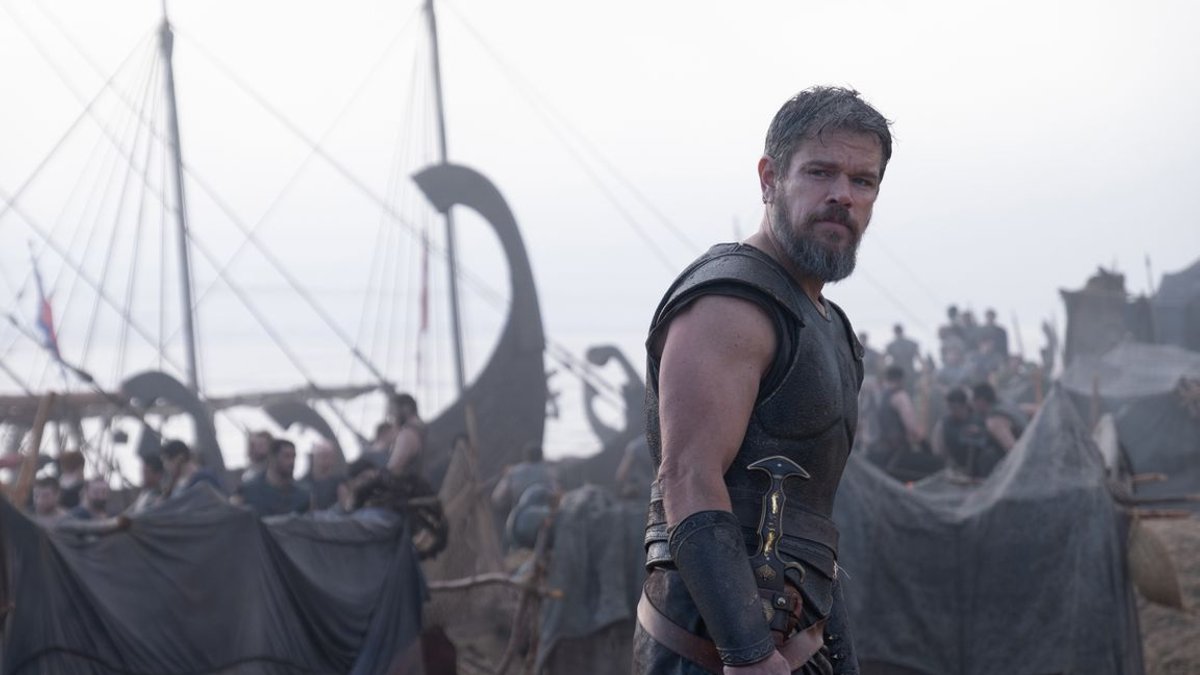
The Odyssey, a hero’s journey filled with magic, monsters, gods, and sorceresses, has been brought to life on the big screen by writer-director Christopher Nolan and production designer Ruth De Jong. To make the fantastical worlds look and feel as physically realized as possible, the two were determined to build entire sets and avoid using blue or green screens.
De Jong recalls asking Nolan about the parameters for the production, and he replied, “The entire world.” This challenge led De Jong and her team to capture the full breadth of the 20-year-long quest of Greek king Odysseus, played by Matt Damon, as he returns to his wife Penelope, played by Anne Hathaway, and son Telemachus, played by Tom Holland, after the Trojan War.
Filming Locations
The 91-day production took place across six different countries, including Scotland, Iceland, Morocco, Greece, Italy, and the United States. De Jong chose atmospheric locales with texture, scale, and a sense of the unknown, such as the rugged cliffs and stormy waters of Scotland, where Odysseus meets Samantha Morton’s Circe, and the black sand beaches of Iceland, which stood in for Hades.
Related: Museums Get the Little Things Right
The production team also filmed in the gorgeous remote coast of Morocco, which was home to Charlize Theron’s sea nymph Calypso. With its diverse locations, the film aimed to bring the ancient world to life in a visually stunning way.
Creating Odysseus’s Ithaca
The ambitious undertaking centered around creating Odysseus’s home base of Ithaca. Exteriors of the Bronze Age palace were filmed at the 15th century-era Castle of Santa Caterina situated high atop the island of Favignana in western Sicily. The megaron, or hall in Odysseus’s home, was constructed on a three-story-high Los Angeles soundstage that spanned the length of two football fields.
De Jong worked hard to make all the ins and outs look seamless, so it would not be obvious that it was a set.
Related: Managing bowing walls in North Dakota and Considering concrete lifting
One of the most impressive aspects of the production was the construction of the sets, including the Temple of Athena and its gates, doors, towers, and stairs. The team built everything that catches fire in the movie, and then utilized the historic mud-brick village in Morocco to enhance the environment.
Crafting Odysseus’s Journey
Each time Odysseus and his fellow warriors sailed the Mediterranean Sea, filming took place on open water. De Jong sourced the main 115-foot-long vessel from Stavanger, Norway, and transformed it into a Greek warship. The functioning boat traveled from Scotland to Morocco, accentuated with bronze decaling on the front and back.
The level of craftsmanship that went into restaging the momentous Trojan War was impressive. The set piece needed to be massive and grand, as Troy was like the New York City of the ancient world. De Jong built two-and-a-half acres worth of sets, including the Temple of Athena and its gates, doors, towers, and stairs.
Related: Disney villain inspires couple’s hidden-door home
As for the iconic Trojan horse, it was designed and built in LA at the start of production and then shipped overseas. The actors actually packed inside the structure’s belly as it sat half-submerged in freezing water on the beach.
Considering the practical implications of this film’s production, it becomes clear that the commitment to building entire sets and filming on location added to the overall sense of realism and immersion. This approach allowed the actors to fully engage with their surroundings, resulting in a more authentic performance.
Overall, the production of The Odyssey was a monumental undertaking that required careful planning, attention to detail, and a commitment to creating an immersive and realistic environment.